

by: Beba Cabello | March 2026
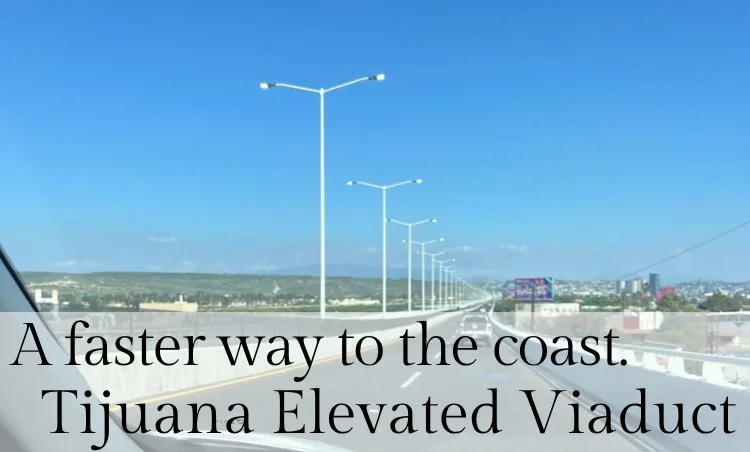
The recent opening of the Tijuana elevated viaduct is already changing how people experience the Rosarito coast. What began as a complex construction phase has now turned into a meaningful improvement in accessibility—one that is starting to influence how people use, enjoy, and invest in property along the coast.
Table of Contents
What We Started Noticing Early On
Having worked in real estate in Rosarito for many years, one thing becomes very clear over time: the market doesn’t move randomly. It responds to real, tangible factors—many of them beyond the properties themselves.
I’ve been part of the local real estate community throughout my career, including AMPI (the Mexican Association of Real Estate Professionals), as well as ongoing conversations with developers along the coast through my work with Palacio del Mar. These are the kinds of spaces where we step back and look at what’s actually influencing activity in the market.
When the viaduct project began—and especially as construction picked up through 2023—it quickly became a recurring topic in those conversations.
During that time, as we were looking at the slowdown in 2023 and into 2024, one factor kept coming up again and again: access.
Not in theory—but in real, everyday experience.
Getting to and from the border became more complicated. Traffic patterns changed, lanes narrowed, and what used to be a fairly predictable drive turned into something you had to plan around.
And naturally, that had an effect.
Some clients started coming less often. Others delayed visits. Not because the interest in Rosarito changed—but because the experience of getting here did.
At the same time, there was also a shared understanding: this was temporary.
A Project That Always Pointed Forward
From the beginning, the viaduct was seen as something the region needed.
A more direct connection between Rosarito, the border, and the airport—avoiding some of the most congested areas of Tijuana—has been a long time coming.
But like most infrastructure projects, the benefits don’t show up immediately.
There’s a phase where things feel slower, more complicated, and at times even discouraging. And that was part of the experience during construction.
Still, little by little, as sections were completed and opened, the flow began to improve. It wasn’t perfect yet—but it was clear things were moving in the right direction.
What Has Changed Now
Now that the elevated viaduct is open, the difference is something you can feel.
What’s more important than total drive time is what happens within that final stretch toward the border.
Before, that section—moving through Tijuana toward the crossing—could easily add 40 minutes of traffic, and during the most difficult phases of construction, even more than an hour just in that portion alone.
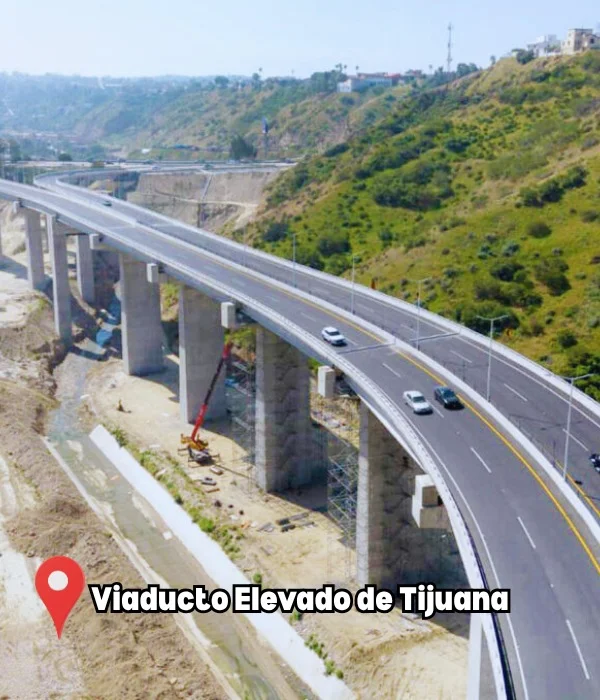
Today, once you enter the elevated viaduct, that same segment moves much more efficiently—often taking around 10 minutes from entry to exit.
That change, by itself, has made a noticeable difference.
But beyond time, what really improved is something more important: consistency.
Why This Matters More Than It Seems
In real estate, access isn’t just about distance—it’s about how easy it feels to come and go.
And that feeling plays a bigger role than most people realize.
When access becomes unpredictable, people hesitate.
When it becomes easier again, activity naturally follows.
That’s what we’re starting to see.
Owners are using their properties more.
Trips feel simpler again.
And for many buyers who had been considering the coast, this removes one of the main points of hesitation.
Not the only one—but an important one.
From Occasional Getaway to Real Option
Rosarito has always offered something compelling: oceanfront living, a mild climate, a slower pace, and strong value compared to Southern California.
What’s changing now is how accessible that lifestyle feels.
For someone living in San Diego—or anyone who wants to stay connected to the U.S.—this shift makes a real difference. It’s no longer just about coming down when everything lines up perfectly. It becomes something you can integrate more easily into your routine.
That shift, while subtle, is powerful.
A Change That Supports What Was Already There
No single project defines a real estate market. There are always multiple factors at play.
But every so often, something comes along that removes friction.
That’s what this feels like.
The viaduct doesn’t change what Rosarito is—it simply makes it easier to access, experience, and enjoy.
And in many cases, that’s exactly what was needed.