

by: Mario Restrepo | August 2026
For Baja Real Estate owners, the Mexican bank trust may be a mysterious document that allows foreigners, non-Mexican nationals, to own coastal property in Mexico. Real estate trust holders, known as beneficiaries, despite paying annual fees to the trust bank, are usually not very familiar with the important information in their trust.
Table of Contents
Your Bank Trust is a great tool that lets you enjoy all the financial and lifestyle benefits your Mexican property can offer. From the Pacific coast to the Sea of Cortez, the Gulf of Mexico, and the Caribbean, non-Mexicans use bank trusts to hold coastal and oceanfront property as their own.
During the period of ownership, information held in the bank trust may come to the forefront for several reasons. One is when owners want to sell their property and face a capital gains tax, ISR, in Mexico, and you want to strategize to pay less tax on the gain.
Another is when you want to make changes to your bank trust, such as naming a new substitute beneficiary. Your trust may also further describe your obligations to your homeowner association, or which land is included with your property, or which land you are responsible for that is not specifically under your roof or fenced in.
Your Mexican bank trust contains important information about your property, ownership rights, beneficiaries, purchase history, and obligations. Here are some key details you should review and understand about your fideicomiso.
Property Size and Survey in Your Mexican Bank Trust
The property size is described in the bank trust. The size of the house or condo, and the size of the land are both listed in square meters. As part of the property description, your bank trust will describe what is adjacent to the subject property, such as neighboring lots, neighboring condos, streets, a service or access road, a green area, or the federal zone. You will find this described in the first page or two of the bank trust, and then again in the survey section of your bank trust.
The surveys section may comprise of several pages within your trust and include the square meters of the land, the square meters of the condo, and unattached parking. If the developer built and sold a single-family house, then the survey will describe it, including its size and neighboring land.
If you purchased raw land and later built a house, the house information will not appear in the current bank trust. However, it should appear in the bank trust for subsequent bank trust holders after new surveys are contributed during future title transfers.
Note that property size in Mexico is measured by total construction area. This contrasts with US standards, which measure the size of the dwelling’s livable space.
Fraccionamiento or Condo Regime
Your bank trust communicates if your property is in a fraccionamiento or a condo regime. If it is in a condo regime, next to the square meters listed as the size of the property, on the first or second page of the bank trust, is a number represented as a percentage and is commonly called the area indiviso, which indicates how much you own of the undivided, common areas.
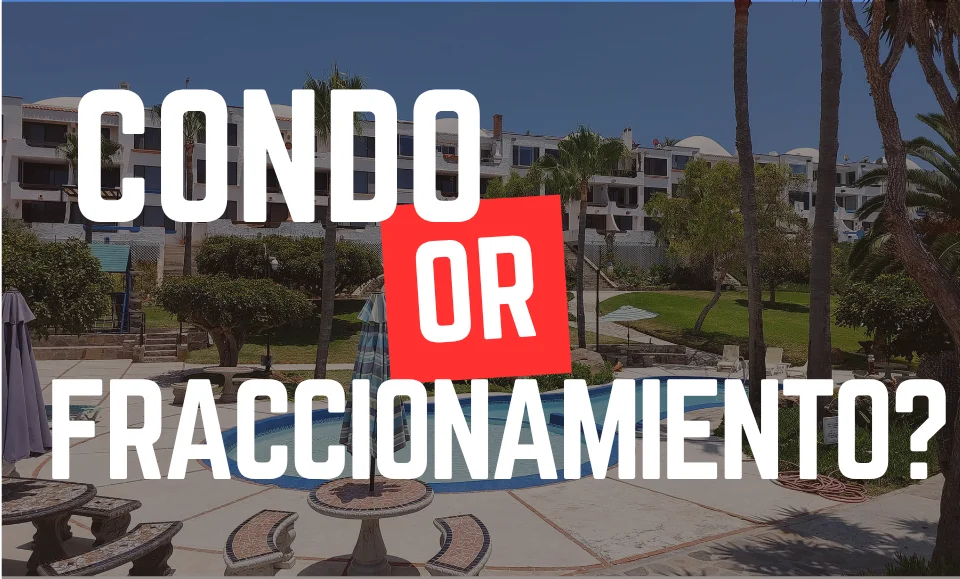
You may read text such as “Condominio” referring not to the specific description of the physical property, such as a condo, but to the infrastructure of the community’s title, meaning a “Régimen de Condominio” or a condo regime, which addresses separate, individual units or condos, with some common, shared, indivisible areas, such as walkways or a swimming pool.
If the property is in a fraccionamiento, it will also state that, using the word Fraccionamiento in the address or description of the property. Simply put, a Fraccionamiento does not have common areas, and the city may own the streets. Park or green areas are usually donated to the city. Yet, fraccionamiento owners maintain park and green areas on a volunteer basis, as the city is usually not in a financial position to do so.
Your bank trust can also indicate whether the property is within a condo regime located within a fraccionamiento. This is usually the case when a small condo building is surrounded by single-family homes or other condo buildings built by other developers on different parcels of land, but that may still share streets and the community entrance.
Bank Trust Owner and Substitute Beneficiaries
The Beneficiary, called the Fideicomisario, a term you may find in your bank trust, is the person who gets to enjoy the property. This is the person who gets to live in the property, fix and maintain it, pay taxes on it, get loans against it, remodel it, and designate the substitute beneficiaries.
If you were to die, the bank trust clearly identifies the substitute beneficiaries. Substitute beneficiaries can be anyone you appoint, such as your surviving spouse, children, other family members, or another trust. One of the exceptional benefits of having a bank trust as title to your Baja property is that your substitute beneficiaries will not have to go through probate or pay taxes to acquire the property if you should pass. The substitute beneficiaries will only need to address themselves as the new primary beneficiaries, and then they can name new substitute beneficiaries.
On a lighter note, some owners forget who is listed on title as the primary beneficiary, meaning was it just themself or also their spouse. One owner had several Mexican properties and did not remember which of the four properties had 75% ownership in an LLC, or which LLC it was. So a simple check of his bank trust reminded him, so he could better strategize for capital gains taxes when he wanted to sell his property.
The Mexican bank is the Fiduciario. This entity holds title without the financial or use benefits the Beneficiary enjoys. The Fideicomitente can be referred to as the Trustor, who is the party who initially created the trust, maybe a developer, or a non-Mexican owner.
Property Type: House, Condo, or Land
Your bank trust will state whether you purchased raw land, or land with an improvement, meaning a house or other structure, or a condo. Generally, a house or condo has a tax advantage over raw land both in annual property taxes and capital gain tax when you go to sell in the future.

If you purchased raw land and later built a house on it, you need to keep your original building permits and your declaration that you have finished construction in a document called “terminación de obra”. After the purchase of the raw land, your building of the house will not be stated in your bank trust. Your bank trust will continue to show that you purchased as raw land.
Keep your terminación de obra document to help minimize capital gains tax when you sell. The buyer of your property can then have their title include the built house on the raw land. Also, keep your blueprints. It makes your place more marketable.
Years Remaining on the Mexican Bank Trust
Further into your bank trust document, the foreign real estate acquisition permit granted by the Secretaría de Relaciones Exteriores (the Mexican Secretary of Foreign Relations) will state the date the permit was issued, so you can determine how many years remain of the 50 years granted for your bank trust. These 50-year permits and trusts can be renewed. Once you get near the 50 years, ask around, particularly the notario or a closing coordinator, as to which bank or institutions are offering competitive bank trust terms; you don’t have to use the same trust bank as competition evolves.
Recorded Acquisition Price of the Property
This is a big fact that many sellers want to double-check. The recorded acquisition price is the base amount used to calculate your capital gain tax (impuesto sobre la renta, ISR) when you sell. This amount is clearly written within your trust. It may be referred to as the “contraprestación” or the “valor de la operación” in the trust and will be quoted in dollars or in pesos; either way, it is based on the exchange rate of that date. This is not the same as the “avalúo”, which means appraised value. The Acquisition Price sets the tone for how you will strategize to minimize taxes if you have a financial gain on the sale of the property, along with the acquisition date and the number of people on title who qualify for Mexican Resident status.
Parking Spaces
If your property is in a vertical condo regime, a condo tower, for example, your bank trust will most likely specify where your parking space is located, or at least state that there is a parking space dedicated to the condo, or included in the total area, total square meters, of your property. Some condo regimes have each parking space mapped, measured, and shown in the survey within your bank trust.
Single-family home properties typically don’t describe parking spaces in their bank trusts, as parking is on the property.
Property Tax ID Number – The Predial
Your property tax ID number is listed in your trust, and you need it to pay your annual property taxes at the start of every year. This number, called a “clave catastral” in Spanish, can also be found on your water bill if you have one. This number may look like this: SA-100-516.
After you purchase your place, you can change the name on the tax bill from the previous owners to yours with your bank trust and ID in hand, usually done at the Municipal building.
Certificates Showing the Property Is Free and Clear of Liens
Documents, or certificates, showing that you have purchased the property free and clear of liens. A Certificate of No Liens, which is called a Certificado de Libertad de Gravamenes, is a document that the notario will include in your bank trust to show there is no debt, bank loans, taxes owed, legal attachments, or judgments that affect the property at the time you formally sign to acquire the property. You will also have a certificate from the State water company confirming that the water account associated with the property is current, and a letter from the association stating that the property is current on its community obligations, particularly if the property is in a condo regime.
Terms of Your Bank Trust
Your bank trust will list its services and the cost of those services. For example, how much is your annual bank trust fee, how much does it cost to cancel the trust, add a primary beneficiary or change a substitute beneficiary, and, very importantly, what is your account number with the trust bank, which might look something like F\18832. Included in this section of your bank trust is the contact information for the trust bank in case you lose information on where and when you need to pay your annual fees. This section will also include the addresses of the parties involved for any legal notices.
Can’t Find Your Mexican Bank Trust? Here’s What to Do

About 2 months after your closing, meaning your signing to acquire title in front of the notario, is when you will most likely be called or emailed by the notario or closing coordinator to pick up your physical original document, which is your bank trust. It is a legal-size document, 8.5 inches by 14 inches. Page 1 of your bank trust states which notario you signed with to receive it and the date it was recorded in the public registry. Having your purchase of real property in Mexico recorded in the public registry is important.
If you lose the physical original document of your bank trust, you can either go to the notario’s office to get a certified copy or go to the public registry to get a certified copy. You can also get an uncertified copy from the Public Registry and save a few pesos.
⊹ · ✧ · ⊹ · ✧ · ⊹
Of course, there is more to what is inside your trust and how it may be important to you. However, above, we have addressed common questions and needs a non-Mexican owner may have who is using a bank trust in Mexico to secure property within the restricted zone.